
Summarize this article with AI
Tetrahydrofuran — THF — is one of those solvents that looks easy to handle until it starts creating problems. Clear liquid, mild ether smell, mixes with water, low boiling point. On paper, nothing unusual.
But inside production, THF behaves sharply. Fast evaporation, strong solvency, and one issue that keeps coming back — peroxide formation.
Because of this, industries don’t treat it casually. When companies start working with Tetrahydrofuran THF suppliers, they usually already know where it will be used and what can go wrong.
This is not a “general solvent” purchase. It is tied to specific applications where performance numbers matter.
Basic working properties (these numbers drive usage)
Before looking at applications, the numbers explain why THF is used at all:
- Chemical formula: C₄H₈O
- Molecular weight: 72.11 g/mol
- Boiling point: ~66°C
- Flash point: ~-21°C
- Density: ~0.889 g/cm³
- Miscibility: completely miscible with water and most organics
Low boiling point means:
- fast evaporation
- easy solvent recovery
High solvency means:
- dissolves polymers, resins, intermediates
But that low boiling point also means loss if handling is poor.
So when industries evaluate Tetrahydrofuran THF suppliers, they look at:
- moisture content
- peroxide level
- inhibitor presence
Because THF performance changes quickly if these are not controlled.
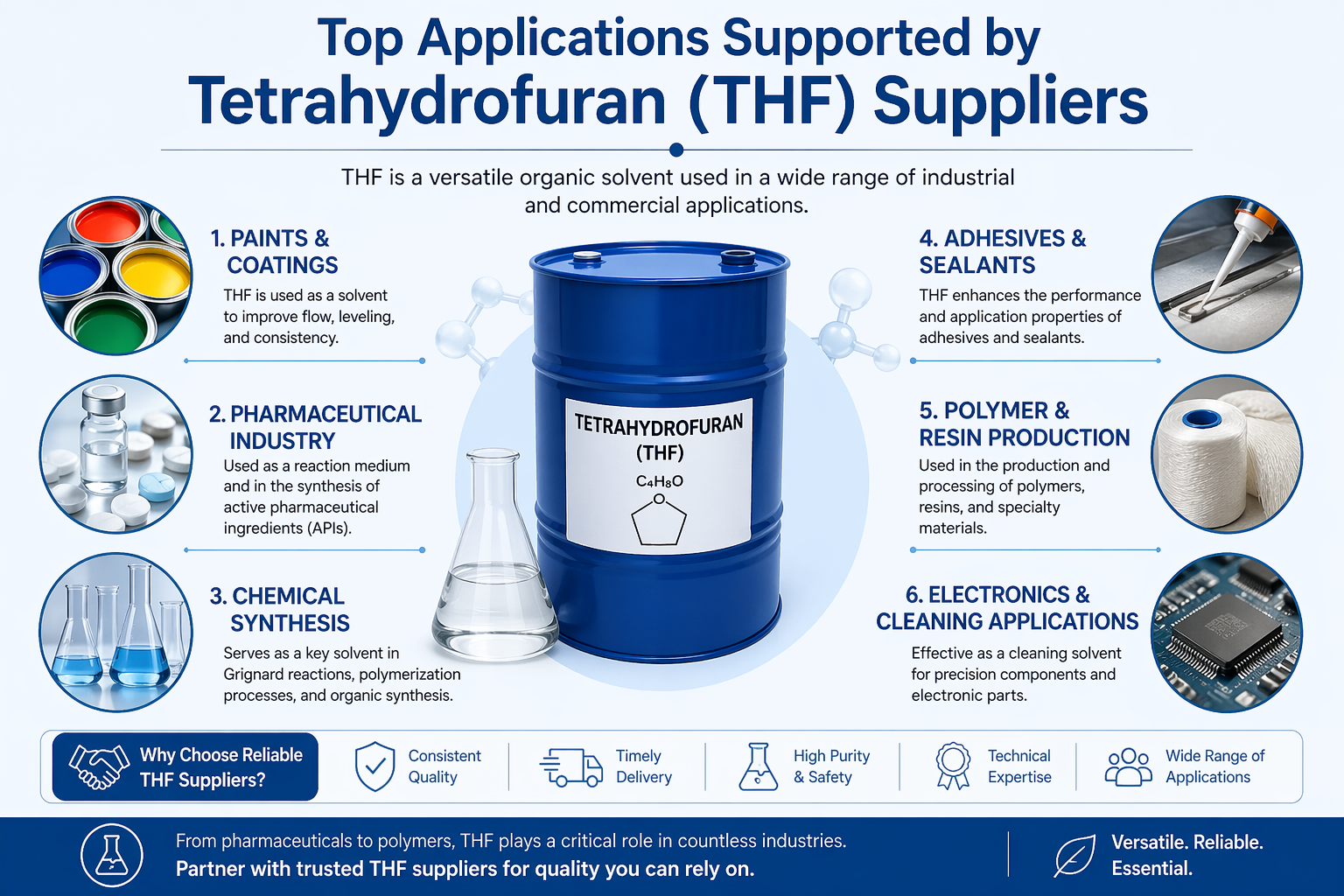
1. Polymer production (PTMEG / spandex chain)
One of the largest uses of THF globally is in producing PTMEG (Polytetramethylene Ether Glycol).
Reaction route:
THF → polymerization → PTMEG
PTMEG is then used for:
- spandex fibers
- elastomers
- thermoplastic polyurethanes (TPU)
Typical data:
- PTMEG molecular weight range: 650–3000
- THF purity required: ≥99.9%
- water tolerance: <0.02–0.05%
Even small water presence affects polymer chain length.
If moisture increases:
- molecular weight drops
- product elasticity changes
So polymer plants working with Tetrahydrofuran THF suppliers strictly monitor:
- Karl Fischer moisture
- inhibitor levels
- peroxide traces
Because polymerization reactions are sensitive to these.
2. Pharmaceutical solvent use (reaction + intermediate stage)
THF shows up frequently in API synthesis.
Reason is simple:
- dissolves both polar and moderately non-polar compounds
- works well in Grignard reactions
- stable at moderate reaction temperatures
Common reaction environments:
- temperature range: 0°C to 60°C
- often used in organometallic chemistry
But pharma use comes with strict conditions.
Typical pharma-grade THF specs:
- purity: ≥99.9%
- water: ≤0.05%
- peroxide: <50 ppm (often much lower required)
Why peroxide matters:
THF forms peroxides when exposed to air + light.
Peroxide levels above 100 ppm can:
- create explosion risk during distillation
- interfere with reactions
So buyers working with Tetrahydrofuran THF suppliers often demand:
- inhibitor-added THF (like BHT ~250 ppm)
- fresh batch supply
- storage under controlled conditions
3. PVC and resin processing (solvent + processing medium)
THF is widely used in:
- PVC (polyvinyl chloride) processing
- specialty resin formulations
Main advantage:
- dissolves PVC effectively at room temperature
Typical use:
- solvent cement for PVC pipes
- coating formulations
In solvent cement:
- THF content often 60–80% of formulation
- fast evaporation allows quick bonding
If evaporation rate shifts (due to impurity or moisture):
- bonding strength reduces
- drying time changes
So manufacturers sourcing from Tetrahydrofuran THF suppliers monitor:
- evaporation rate consistency
- residue after drying
- impurity content
4. Adhesives and coatings (fast-drying systems)
THF is used in adhesives where:
- quick setting required
- strong bonding needed
Key reason:
- boiling point ~66°C → rapid evaporation
Typical industrial adhesives:
- pipe joining compounds
- specialty coatings
Performance depends on:
- evaporation uniformity
- solvent purity
Even 1–2% heavy impurity can:
- leave residue
- affect surface finish
That’s why formulation companies evaluate Tetrahydrofuran THF suppliers based on:
- distillation range
- non-volatile residue
- color stability
5. Chemical intermediate production
THF is used as reaction medium in:
- agrochemicals
- specialty chemicals
- fine chemical synthesis
Especially useful in:
- organolithium reactions
- Grignard reactions
Because:
- stabilizes reactive intermediates
- allows controlled reaction environment
But peroxide presence is critical here.
Above certain levels:
- reaction side products increase
- safety risk increases
Industrial limit usually kept:
- <50 ppm peroxide
So chemical plants working with Tetrahydrofuran THF suppliers often test peroxide on arrival, not just rely on supplier data.
6. Extraction processes (limited but specific use)
THF is sometimes used in extraction where:
- mixed polarity required
- faster separation needed
Compared to hexane:
- THF dissolves wider range of compounds
But downside:
- higher cost
- higher reactivity
So use is selective.
In such cases, solvent purity directly affects:
- extraction yield
- downstream separation
That is why even in limited use, buyers stay careful when selecting Tetrahydrofuran THF suppliers.
7. Laboratory and R&D use (small volume, high sensitivity)
In labs, THF is used for:
- reaction trials
- analytical preparation
- chromatography
Here, even trace impurities matter more than bulk applications.
Typical lab-grade requirements:
- purity ≥99.9%
- peroxide <10–20 ppm
- stabilized or freshly distilled
Researchers often re-distill THF before use.
That itself shows how sensitive it is.
So suppliers providing to R&D setups must maintain tighter control.
8. Peroxide formation problem (this is the main risk)
THF reacts with oxygen over time.
Reaction leads to:
- organic peroxide formation
Conditions that accelerate it:
- exposure to air
- light
- long storage
Typical buildup:
- fresh THF: <10 ppm
- after storage: can exceed 100 ppm if uncontrolled
Above 100 ppm:
- hazardous during distillation
- explosion risk increases
That’s why:
- inhibitors like BHT (~250 ppm) added
- storage in sealed containers required
Buyers evaluating Tetrahydrofuran THF suppliers always check:
- peroxide level
- inhibitor presence
- storage instructions
Because this is not optional safety check.
9. Storage and handling limits
THF storage conditions:
- temperature: below 25°C preferred
- away from light
- airtight containers
Shelf life typically:
- 6–12 months with inhibitor
- shorter without stabilizer
Moisture also matters:
- water content should stay below 0.05–0.1%
Above that:
- reaction performance drops
- solvent behavior changes
So industries prefer suppliers who manage storage before dispatch properly.
10. Industrial supply chain example
Vastani Chemicals Limited operate in supply networks where THF is treated as a controlled solvent, not a general commodity.
Here, quality is not judged only at dispatch.
It is judged after:
- storage
- reaction
- recovery
Because THF changes with time if not handled correctly.
Final observation
Tetrahydrofuran is used because it works where many solvents don’t.
- strong solvency
- low boiling point
- compatibility with multiple systems
But it also comes with conditions:
- peroxide control
- moisture control
- storage discipline
That is why industries don’t casually select Tetrahydrofuran THF suppliers.
They look at:
- purity stability
- peroxide levels
- handling practices
Because with THF, problems don’t usually show immediately.
They show later — during reaction, during distillation, or during storage.
And by then, correction becomes expensive.
So the real selection criteria is not just:
“Is THF available?”
It is:
“Will this THF behave the same after 3 months, inside the process?”
