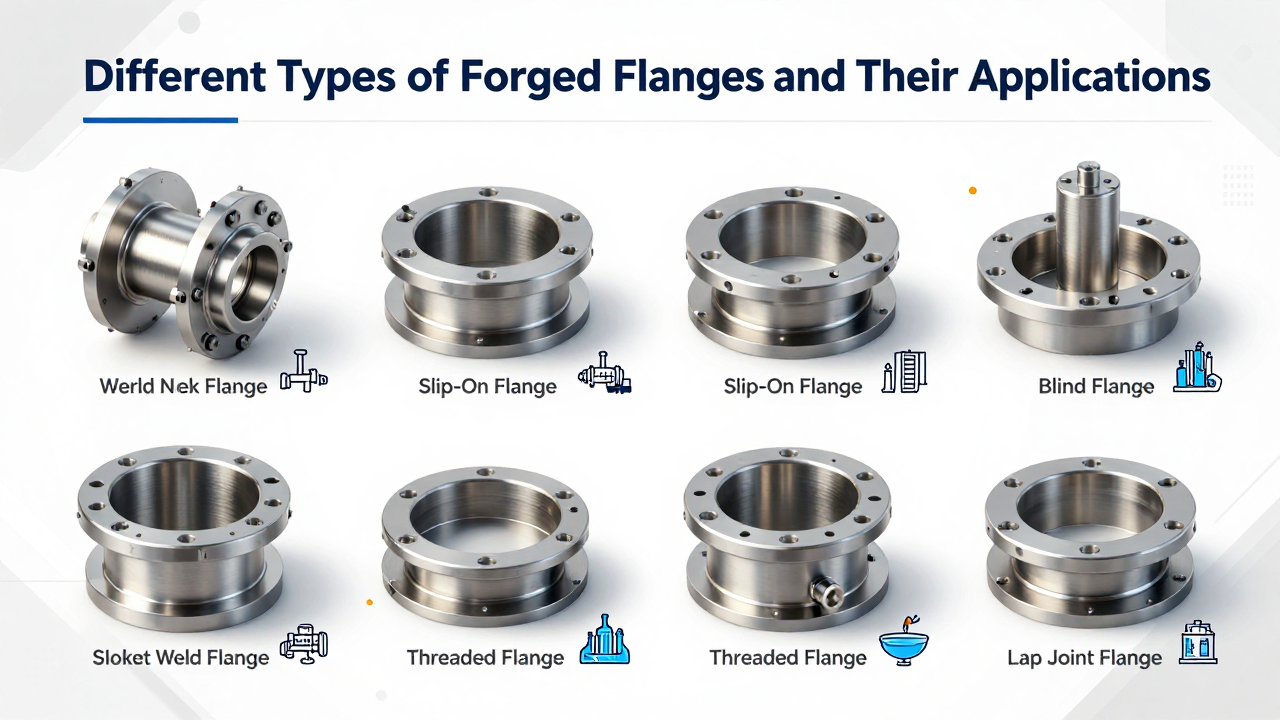

Forged flanges are the joining pieces that assemble the pipes, valves, pumps, and vessels in a real working plant. They are everywhere: in oil refineries that crack crude oil into gasoline and plastics; in chemical plants that mix acids and other noxious chemicals; in power stations that drive steam engines; in off-shore platforms that battle the waves; and in ship engines that bounce with vibration. People use forged flanges rather than cast or plate flanges because the hammer blows on the metal press the metal grains into a flowing pattern around the bolt circle and hub rather than straight across.
Every forged flanges type has its own shape, hub design and fixing method. Some carry massive pressure and need bullet-proof joints. Others just need to be cheap and quick to bolt on water lines. Some allow easy dismantling for cleaning, while a few are built specially for measuring flow or blocking lines completely. Picking the wrong type can mean constant leaks, extra welding time or sudden failure during a startup. Here is how the main types actually get used in the field.
Table of Contents
Weld Neck Flanges
Weld neck forged flanges are the ones you trust when things get really tough. They come with a long, slowly tapering hub that matches the pipe thickness. When the welder finishes the butt weld, the joint looks almost like one continuous pipe. Stress spreads out nicely instead of concentrating at the weld root.
These forged flanges go on high-pressure steam headers, boiler outlets, reactor feed lines, hot oil transfer lines and anything that sees big temperature swings. They are made in Class 150 up to Class 2500. In refineries they survive years of daily heating and cooling without cracking. The long hub also lets inspectors shoot clear X-ray films of the weld. Normal material is A105 carbon steel, but F11 or F22 alloy versions handle hotter lines and F304/F316 stainless takes care of corrosive fluids.
Slip-On Flanges
Slip-on forged flanges are the practical, budget-friendly choice for everyday jobs. The pipe simply slides into the flange and two fillet welds seal it — one from inside the bore and one from outside. Fitting is fast and does not need highly skilled welders.
You find slip-on forged flanges on cooling water circuits, fire water rings, utility air headers, low-pressure condensate lines and similar non-critical services. They normally stay in Class 150 to 600 range. Many maintenance engineers like them because they are cheap and quick to replace during turnarounds. However, the double fillet weld can become a weak spot under heavy vibration or pressure cycling, so smart plants keep them away from critical hydrocarbon lines.
Socket Weld Flanges
Socket weld forged flanges have a deep pocket machined inside. The pipe end drops into this socket and one neat fillet weld closes everything. The bore stays almost smooth, so there is very little turbulence in small lines.
These forged flanges are favourites for instrument tapping points, chemical injection lines, hydraulic control lines and steam tracing — almost always 2-inch and smaller. They handle up to Class 1500 comfortably. Stainless socket weld forged flanges are very common in pharmaceutical and food-grade plants because the smooth inside is easy to clean. A small 1.6 mm gap is deliberately left at the bottom of the socket so the weld can fill properly and the pipe can expand without cracking the weld.
Threaded Flanges
Threaded forged flanges are the no-weld option. The inside of the flange has threads that match the pipe threads. You just screw the pipe in and tighten — no hot work required.
They are handy in explosive areas, temporary bypass lines, instrument air headers and places where welding permits are difficult to get. Threaded forged flanges normally come in small sizes up to 6 inches and lower pressure classes. They are not suitable for high temperature or constant vibration because threads can loosen or strip over time. Still, when you need a quick, spark-free connection, these forged flanges save a lot of headaches.
Blind Flanges
Blind forged flanges are simply solid steel discs with no hole in the centre. They blank off pipe ends, valve outlets or vessel nozzles during maintenance or pressure testing.
These forged flanges have to take the full system pressure, so they are made in every class from 150 to 2500. Most have a couple of tapped holes so riggers can lift them easily or fit a pressure gauge. Refinery shutdown teams bolt blind forged flanges on pump suctions and spare nozzles. Offshore platforms keep them ready on manifold branches that might be used later.
Lap Joint Flanges
Lap joint forged flanges never weld directly to the pipe. A separate stub end gets welded to the pipe first, then the loose flange slips over the stub like a ring. The flange can rotate freely to line up bolt holes perfectly.
This type is useful when the line needs frequent opening for cleaning or when you want to save money — stainless stub ends with cheaper carbon steel lap joint forged flanges. They handle moderate pressure and temperature but are rarely used in very critical or high-pressure services.
Orifice Flanges
Orifice forged flanges come as matched pairs with two small pressure tap holes and jack screws. An orifice plate sits between them to create a measured pressure drop for flow calculation.
Gas metering stations, custody transfer lines and process plants use orifice forged flanges daily. They are usually weld neck style but can be slip-on. The jack screws let operators separate the flanges to change the plate without cutting the pipe. Everything is machined to tight tolerances so the orifice plate sits dead centre.
Spectacle Blinds
Spectacle blind forged flanges look exactly like the number 8 — one half is a solid blind, the other half is an open ring spacer. Workers simply swing the blind side across the line to isolate flow or the open side to let it through. The position is visible from ten metres away, so mistakes are almost impossible.
Refineries and chemical plants install spectacle blind forged flanges at every important isolation point. Separate spade blinds do the same job but come as single loose pieces instead of one connected unit.
Long Weld Neck Flanges
Long weld neck forged flanges have an extra-long hub, sometimes 300 mm to 600 mm. They replace the usual weld neck flange plus a short pipe spool at vessel nozzles.
Heat exchangers, reactors and tall columns use long weld neck forged flanges heavily. One solid piece means fewer welds, better stress distribution and longer life under constant thermal cycling. The extra length also moves the weld away from the high-stress area right next to the vessel shell.
Real Plant Usage
In oil refineries you mostly see weld neck and blind forged flanges on hot hydrocarbon lines. Power stations rely on weld neck forged flanges for superheated steam. Ships use slip-on and socket weld forged flanges for fuel and fire mains. Chemical plants like orifice and lap joint forged flanges for flow measurement and cost control. Pharma units prefer stainless socket weld forged flanges because they are easy to sanitise.
Common Materials
Everyday forged flanges are A105 carbon steel. Hot services use F11 or F22 alloy. Corrosive lines take F304 or F316 stainless. Seawater and sour gas lines need duplex F51 or F53. Special jobs often demand low-temperature impact tests or NACE hardness limits.
Final Thoughts
There are so many different types of forged flanges because real plants have so many different needs. Weld neck forged flanges provide strength for hazardous high-pressure piping systems, slip-on forged flanges save money for straightforward utility applications, socket weld forged flanges provide a tight fit for instrument applications, blind and spectacle types provide safe isolation, and orifice forged flanges provide records for flow measurements. When the proper forged flanges are selected for the actual pressure, temperature, and service fluid, the connections stay tight and the plant operates safely with leaks and shutdowns being a rarity.
